

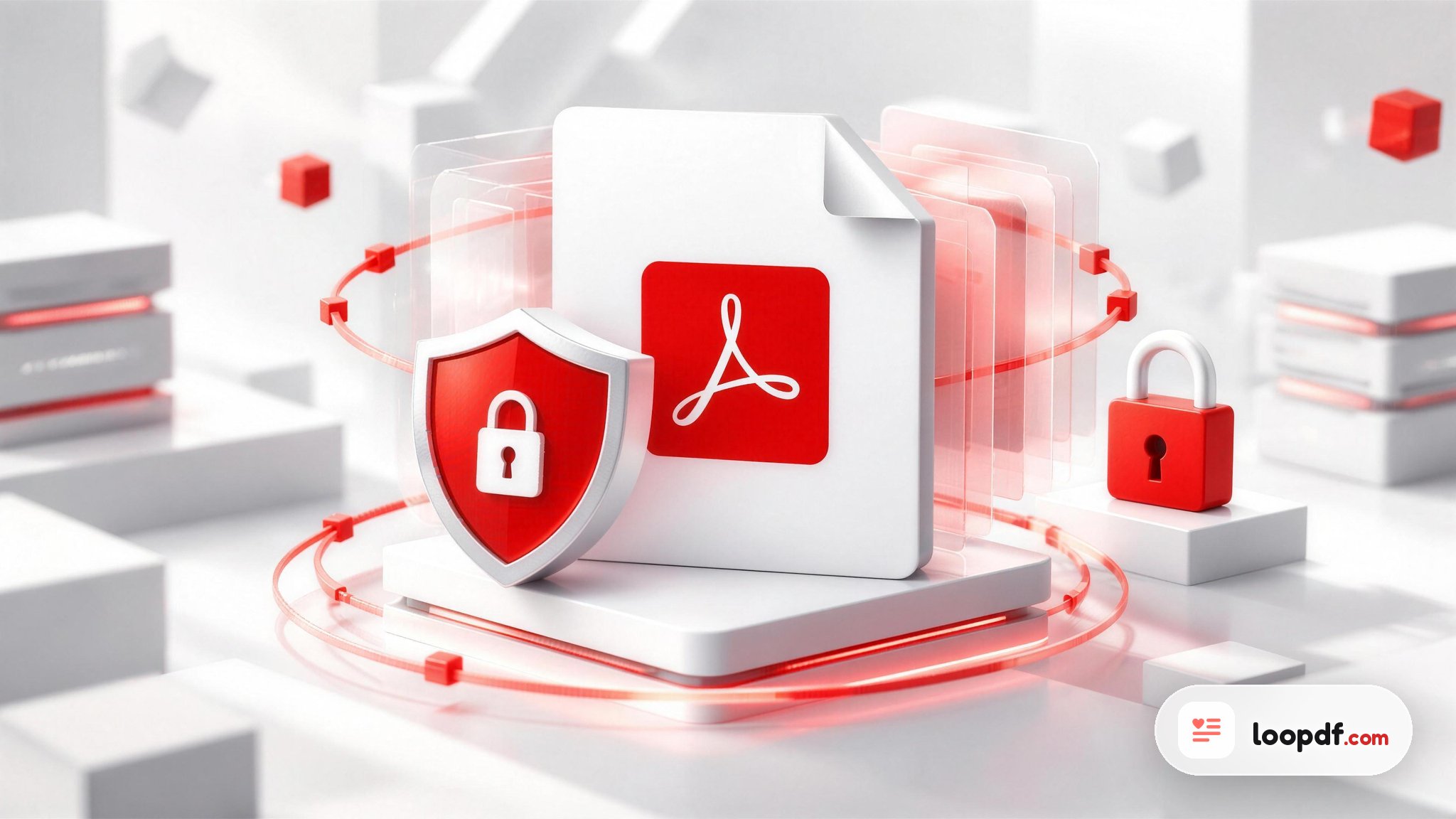
Good PDF security comes down to four controls: a strong password, real encryption, the right permissions, and a tool that never gets a copy of your file. This guide covers each one and the mistakes that quietly undo them.
- Use a user password to control who opens the file and an owner password to control what they can do with it.
- Encrypt with 256-bit AES, and send the password through a different channel than the document itself.
- Layer permissions and watermarks on top rather than trusting a single measure.
- Prefer tools that process the file in your browser, so neither the document nor the password leaves your device.
On this page
Why PDF Security Matters
PDF files are one of the most widely used document formats for sharing information across different platforms and devices. Their popularity makes them a prime target for cybercriminals and unauthorized users. When you send an unprotected PDF, anyone who intercepts it can view, copy, edit, or distribute your content without permission.
Consider the risks involved. Business contracts might contain trade secrets. Medical records include private health information. Financial statements reveal sensitive account details. Without proper security measures, this information becomes vulnerable the moment you hit send. Data breaches can result in financial losses, legal consequences, and damaged reputations that take years to rebuild.
Organizations that handle sensitive data face additional compliance requirements. Regulations like GDPR, HIPAA, and SOX mandate specific security measures for document handling. Failing to secure PDFs properly can lead to hefty fines and legal action. Even for personal use, protecting your documents prevents identity theft and maintains your privacy in an increasingly connected world.
Essential PDF Security Methods
Password Protection
A password is the first control most people reach for, but on its own it is not enough: a short or reused one can be guessed, and it does nothing once a recipient has opened the file and passed it on. Its strength also depends on the encryption behind it and on how you deliver it, so send the password through a different channel than the document. When you password protect a PDF, treat it as one layer alongside encryption, permissions, and watermarks.
Password-protect a PDF now128-bit AES encryption applied in your browserEncryption Standards
Encryption converts your document into coded text that only authorized users with the correct key can read. Modern PDF tools offer different encryption levels, with 256-bit AES (Advanced Encryption Standard) being the strongest option currently available for PDFs.
The encryption level you choose depends on your security needs. For highly confidential business documents or personal information, always select the highest encryption level available. While older PDF readers might not support newer encryption standards, most users today have updated software that handles 256-bit AES encryption without issues.
Digital Watermarks
Watermarks add visible or invisible marks to your PDF pages that identify the document owner and discourage unauthorized distribution. Visible watermarks appear as text or images overlaid on your content, while invisible watermarks embed hidden information that can track document usage.
Use watermarks when you need to share documents but want to maintain ownership rights or track distribution. They work especially well for draft versions, confidential reports, or copyrighted materials. Combine watermarks with other security measures for comprehensive protection, as watermarks alone won't prevent determined users from copying content.
Permission Settings and Digital Rights Management
Permission settings limit what a reader can do with a file once it is open, and they sit on top of the password as a second layer. You can lock PDF printing, editing and copying in the same step as adding the password.
Digital rights management (DRM) takes permissions further by enforcing rules even after distribution. DRM systems can set expiration dates, limit the number of times a document can be opened, or restrict access to specific devices or locations. While DRM offers strong control, it requires compatible PDF readers and can complicate legitimate document use.
Digital Signatures
Passwords and permissions decide who gets in and what they can do. A digital signature answers a different question: whether the file in front of you is still the one that was approved. A cryptographic signature binds the document to a signer's certificate, so any later edit breaks the signature and the reader flags it. A drawn or typed signature image looks similar but proves nothing about the content, because it is only a picture placed on the page. If you are working out which of the two a document actually needs, read our guide to e-signatures versus digital signatures.
Key Takeaways:
- Always use strong passwords with at least 12 characters combining letters, numbers, and symbols
- Choose 256-bit AES encryption for maximum security on sensitive documents
- Layer multiple security methods like passwords, encryption, and watermarks for comprehensive protection
- Set appropriate permissions to control printing, copying, and editing capabilities
- Prefer tools that encrypt in your browser so the file and its password never reach a server
Where Your Files Get Processed
Encryption settings only tell half the story. The other half is which machine does the work. Many online PDF tools upload your document to a server, encrypt it there, and send it back. For that round trip, the unprotected file and often the password itself sit on infrastructure you do not control, governed by a privacy policy you probably did not read.
Browser-based tools take a different route. The PDF is read by your browser, encrypted locally, and saved straight back to your device, so nothing is transmitted. Most loopdf tools work this way, including Protect PDF, which applies 128-bit AES encryption with optional owner password and printing, copying, and modification permissions without your file leaving the tab.
Before you use any tool on a sensitive document, check two things: whether processing is local or server-side, and what happens to uploaded files afterwards. A tool that deletes files after an hour still had them for an hour.
For which tools upload and which don't, see are online PDF tools safe.
Common PDF Security Mistakes to Avoid
Many people unknowingly compromise their document security through simple mistakes. One frequent error is using weak or predictable passwords. Passwords like "password123" or a company name followed by the current year take seconds to crack with basic tools. Another common mistake is sending the password in the same email as the protected PDF, which defeats the entire purpose of password protection.
Some users apply security settings but forget to verify them before sharing. Always test your protected PDF by opening it in a different PDF reader to confirm that passwords work correctly and permissions are properly enforced. Different PDF software handles security features differently, so testing prevents surprises for your recipients.
Relying on a single security method creates vulnerability. If someone cracks your password, an unencrypted document becomes completely exposed. Combining multiple security layers means that even if one measure fails, others still protect your content. Think of it like home security - you wouldn't rely on just a lock or just an alarm system, but use both together.
Hiding text instead of removing it is the mistake that catches people out most often. Drawing a black rectangle over a name, or covering it with a highlight annotation, leaves the original text sitting in the file underneath, where anyone can select it, copy it, or pull it out with a text extractor. Real redaction deletes the underlying content rather than covering it. loopdf's Redact PDF draws the boxes and removes what sits beneath them, in your browser.
Another mistake is over-securing documents that don't need heavy protection. Excessive security can frustrate legitimate users and create workflow bottlenecks. Match your security level to your content's sensitivity. Public marketing materials need minimal security, while financial records require maximum protection.
Pro Tip:
- Create a security checklist for different document types in your organization
- Classify documents as public, internal, confidential, or highly confidential
- Apply standardized security measures based on classification level
Conclusion
Protecting your PDF files doesn't require advanced technical skills, but it does demand attention and consistent application of security best practices. By implementing strong passwords, using encryption, adding watermarks when appropriate, and setting proper permissions, you create multiple barriers against unauthorized access. Remember to avoid common mistakes like weak passwords or sending credentials insecurely. The time you invest in securing your documents today prevents potential disasters tomorrow. Start applying these PDF security best practices to every sensitive document you share, and make document protection a standard part of your digital workflow.
Ready to lock the document before you send it?
- Set a user password so only the people you choose can open the file
- Add an owner password and decide whether printing, copying, and editing are allowed
- Get 128-bit AES encryption applied in your browser, so the file and the password never reach a server
Frequently asked questions
They solve different problems, so neither is safer in every case. A password controls who can open the file, but everyone who has it still sees everything inside. Redaction removes the content itself, so it is gone for every reader, with or without a password. Use Redact PDF for details that no recipient should see, and add a password when the whole document needs to stay private.
While no security is completely unbreakable, strong passwords combined with 256-bit AES encryption make PDFs extremely difficult to crack. Weak passwords can be broken quickly using brute force tools, but complex passwords with 12+ characters using mixed character types would take years to crack with current technology. Always use strong passwords and high encryption levels for sensitive documents.
Most PDF editors include a watermark option, and browser-based tools do the same without an upload. loopdf's Watermark PDF takes either a text string or an image, lets you set opacity, font size, and colour, and places it in the centre or any corner. You can also give it a page range so only the pages you name are marked.
For maximum security, use 256-bit AES encryption, which is the current industry standard for protecting sensitive information. For less sensitive documents, 128-bit AES encryption provides adequate protection. Avoid older 40-bit or 128-bit RC4 encryption as these are outdated and easier to compromise. Most modern PDF readers support 256-bit AES without compatibility issues.
It depends entirely on where the processing happens. Tools that upload your document to a server ask you to trust that server with the contents and often the password too. Browser-based tools encrypt locally, so nothing is transmitted. loopdf's Protect PDF encrypts in your browser for that reason. Check the privacy policy and confirm whether processing is local before you hand over anything confidential.